

Intermediate alloy is a kind of metal as the matrix, one or several elements are added to it, in order to solve the problem of easy burning, high melting point is not easy to melt, high density is easy to segregate and other problems, or to improve the performance of the alloy special alloy, is an additive type of functional material.
Various matrix alloys and additives required for the smelting of steel, cast iron, superalloy, titanium alloy, magnetic alloy, aluminum alloy and non-ferrous metal materials. It cannot be used directly as a metal material. Intermediate alloys are composite alloys composed of more than two elements, except for mass-produced iron alloys. The composition of the intermediate alloy is complex and there are many varieties, which are designed according to the composition of the metal materials and special requirements. Its classification can be divided into iron base alloy, nickel base alloy, aluminum base alloy, etc., according to the matrix composition, it can also be classified according to the main element of the alloy, but it is often called special alloy, in order to distinguish it from the mass production of iron alloys, such as silicon special alloy, calcium special alloy, boron special alloy, chromium special alloy, etc.; It can also be called composite alloying agent, composite deoxidizer, composite refining agent, composite additive (refining agent and alloying agent), intermediate alloy for vacuum smelting, inoculant, spheroidizing agent, creep agent, grain refiner, denaturating agent, etc.
From the definition of the intermediate alloy, it can be seen that the intermediate alloy has the following characteristics:
(1) To a metal as the matrix, its content is generally greater than or equal to 50%, such as aluminum, copper, iron, etc.;
(2) The simple substance to be added is generally easy to burn, high melting point, high density and easy segregation, which should not be directly added;
(3) Intermediate alloy is an additive type of functional alloy material, unlike cast aluminum alloy, deformed aluminum alloy, copper alloy, steel, etc., which is directly used in the production of castings.
Compared with the element to be added, the intermediate alloy generally has a lower melting point, a faster dissolution rate, a more stable real yield, and a stronger ability to improve the performance of the alloy. Therefore, the intermediate alloy can be used for the accurate addition and composition adjustment of the elements in the alloy production process, refining the grain, metamorphic treatment, purification treatment, deoxidation desulfurization treatment, solid solution hardening, etc. It is widely used in aluminum and aluminum alloy, copper alloy, steel and other industries. 1
Intermediate alloy according to the different matrix can be divided into: aluminum base intermediate alloy, copper base intermediate alloy, iron base intermediate alloy, magnesium base intermediate alloy, nickel base intermediate alloy and so on.
Intermediate alloy according to the use can be divided into: alloyed type intermediate alloy (addition type intermediate alloy), grain refinement type intermediate alloy, metamorphic type intermediate alloy, purification type intermediate alloy, deoxidation and sulfur removal type intermediate alloy.
Alloyed intermediate alloy Alloyed intermediate alloy is also called additive intermediate alloy, the main role is to add certain elements to the melt. Compared with the melt matrix elements, these elements generally have the following characteristics:
(1) High melting point, such as adding Si, Fe, Cr, Cu, V and other elements in aluminum;
(2) volatile burning loss, such as adding Mg, Ca and other elements in aluminum;
(3) poor wettability, such as adding B, C and other elements in aluminum;
(4) The density difference is large, easy segregation, such as adding Bi, Sn and other elements in aluminum.
If these elements are directly added to the melt in the form of elemental elements, it is necessary to increase the adding temperature, extend the melting time, or increase the burning loss during the addition process, and the real yield is difficult to guarantee, resulting in multiple adjustments of the composition before the furnace, affecting the production efficiency of the product. Therefore, in order to reduce production costs and obtain more accurate alloy composition, the above elements are generally added in the form of intermediate alloys. The commonly used alloyed intermediate alloys in industrial production are: Al-Si, Al-Fe, Al-Cr, Al-Cu, Al-Mn, Al-V, Al-Zr, Cu-Mg, Cu-Li, Cu-Ca, etc.
Grain refinement type intermediate alloy
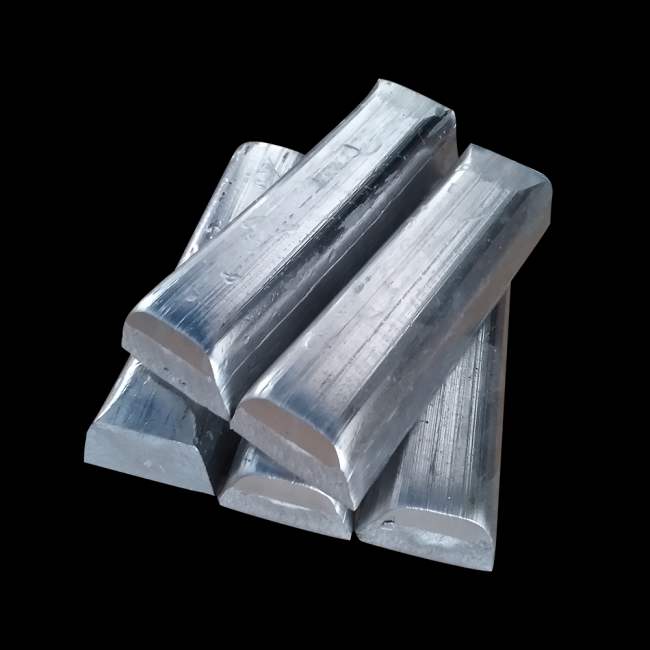
After the grain refinement type intermediate alloy is added to the melt, a large number of heterogeneous nucleation cores are released, which can be used as foreign nucleation nuclei during melt solidification, affecting the nucleation process of melt crystallization, thus playing the role of refining alloy grains. The main products of aluminum alloy grain refinement type intermediate alloy at home and abroad are: Al-Ti, Al-Ti-B, Al-Ti-B-Re, Al-Ti-C, Al-Ti-B-C, etc. Copper alloy grain refinement type intermediate alloy products mainly include Cu-B, Cu-Fe, Cu-Zr, etc., of which Cu-B intermediate alloy can be used for the grain refinement of brass, Cu-Fe intermediate alloy can be used for the grain refinement of aluminum bronze, Cu-Zr intermediate alloy can be used for the grain refinement of brass.
Al-Ti and Al-Ti-B intermediate alloys are widely used in industry because of their high cost performance in grain refinement of aluminum alloys. The refining effect of Al-Ti-B intermediate alloy is better than that of Al-Ti intermediate alloy due to the biphasic nucleation of TiAl3 and TiB2. However, the TiB2 particles in the Al-Ti-B intermediate alloy have a relatively obvious aggregation phenomenon, and when the aluminum alloy contains Zr, Cr, V, Mn and other alloying elements, it will seize the B in the TiB2 particles, forming the corresponding borides, so that the TiB2 particles occur "poisoning" phenomenon, so that the thinning agent weakens or loses its effect. Al-ti-b-re, Al-Ti-C, Al-Ti-B-C are new grain refiners, which overcome (or partially overcome) the above shortcomings of Al-Ti-B intermediate alloys. Al-ti-b-re intermediate alloy is a rare earth mixture added on the basis of Al-Ti-B intermediate alloy. Rare earth is a surface active element, which can increase the wetting Angle between aluminum melt and AlTiRE, TiAl, TiB2 particles, improve the spreading property, and effectively avoid particle aggregation or precipitation phenomenon. However, the severe segregation phenomenon of TiB2 and other particles can only be alleviated to a certain extent, so the whole preparation process still needs strong agitation. Al-Ti-C grain refiner overcomes the shortcomings of Al-Ti-B to a certain extent, and its heterogeneous nucleation core TiC has a smaller aggregation tendency than TiB2, and is immune to Zr, Cr, V, Mn and other elements "poisoning", but the economic addition method of C element, the stability of refinement effect and industrial scale production still need to be further studied. 2
The modified intermediate alloy Al-Si alloy has excellent casting performance, but with the increase of silicon content, there will be a large number of needle, sheet eutectic silicon and plate primary crystalline silicon in the alloy structure, which seriously cracks the alloy matrix, increases the cracking tendency, makes the alloy brittle, and significantly decreases the mechanical properties. Therefore, when the silicon content of Al-Si alloy exceeds 6%, it is generally necessary to undergo metamorphic treatment, that is, to change the eutectic silicon from the thick needle and sheet to the fine fiber and blade shape, and to change the primary crystalline silicon from the thick plate to the fine particle shape. The common intermediate alloys of eutectic silicon are Al-Sr, Al-Sb, Al-RE, etc., and the common intermediate alloys of primary silicon are Al-P, Cu-P, etc.
Purification type intermediate alloy mainly refers to Al-B intermediate alloy, which is mainly used for the purification treatment of aluminum for electrical purposes. The purification mechanism is that the B element in the intermediate alloy can form TiB2, VB2, CrB2 and other dense intermetallic compounds with Ti, V, Cr and other impurity elements in the aluminum liquid that affect the conductivity, and settle at the bottom of the furnace through the action of gravity, so as to purify the aluminum liquid and improve the conductivity.
Purpose Intermediate alloys are used for:
(1) Obtain metal materials with accurate chemical composition and uniform distribution. If the content of less elements in the metal material components is added, the distribution uniformity of the added elements in the material can be improved. Such as using vanadium aluminum alloy to add vanadium smelting Ti-6A1-4V alloy.
(2) Add chemical activity, low melting point, volatile elements. Intermediate alloys such as boron, calcium, magnesium, etc. The use of intermediate alloys can reduce the burning loss of elements during addition, and obtain a stable alloy composition and a higher element yield.
(3) Add high melting point metal. Intermediate alloys such as tungsten, molybdenum, titanium, niobium, chromium, etc., can reduce the melting temperature, shorten the melting time of metal materials and reduce the smelting temperature.
(4) The use of intermediate alloys can add a variety of elements at the same time, so that the refining and alloying of smelting alloys are completed at the same time. Simplified smelting operation and reduced refining time.
(5) The use of pure intermediate alloys can reduce the content of impurities in metal materials. Intermediate alloys with a "VQ" grade are used for vacuum smelting.
(6) Reduce the production cost of metal materials. The requirement for the intermediate alloy is that the melting point is as low as possible; The chemical composition is uniform and the segregation is small. No visible non-metallic inclusions; Low gas content; The content of impurities must meet the requirements of the metal materials smelted; Easily broken and stored in air without deterioration. 3
Production method (1) fusion synthesis method, the composition of the intermediate alloy is complex, the composition range is narrow, and the physical and chemical properties of the component elements are very different, so the fusion synthesis method is an important method for the production of intermediate alloys. The raw materials used are pure metals such as aluminum, magnesium, silicon, manganese, nickel and various refractory alloy elements, various intermediate alloys (mostly binary alloys) and iron alloys, as well as some recyclable scrap metal materials. The melting equipment is mostly induction furnace, but also electric arc furnace and other melting equipment. The metal with the highest content and lower melting point of the refined alloy is melted first. Then the elements with higher melting points and less content are added to dissolve and make an alloy. When melting the intermediate alloy, a small amount of flux protection needs to be added to avoid gas entering the alloy, and some impurities can also be removed. After melting, it is necessary to stir fully to make the composition uniform after casting ingot. Some high quality intermediate alloys need to be melted and cast in a vacuum or in a protective atmosphere.
(2) electrosilicothermal method. Mainly used for the production of silicon series intermediate alloys. Such as composite deoxidizer, composite alloying agent and denaturant.
(3) Thermit method (or electric thermit method).
(4) Molten salt electrolysis method. It is used to produce intermediate alloys of chemically active elements, such as rare earth iron alloys and rare earth aluminum alloys.